Ever wondered why some photos grab your attention and refuse to let go? The secret isn't just expensive gear; it's the art of composition. Mastering a few key composition photography techniques can dramatically elevate your images from simple snapshots to compelling visual stories that resonate with viewers. Understanding these principles is the single most impactful step you can take to improve your work, whether you're a seasoned pro looking for a fresh perspective or a beginner eager to learn the fundamentals.
In this comprehensive guide, we'll break down 10 essential techniques, from the classic Rule of Thirds to the dynamic use of leading lines and negative space. We provide practical examples, common mistakes to avoid, and quick tips to enhance your portraits and selfies, making them perfect for creating stunning avatars with tools like AnimePhoto.ai. While these principles are critical for static images, their influence extends into moving pictures as well. For insights into how these principles are leveraged to capture attention in dynamic content, consider resources on photography in viral video marketing. Get ready to transform how you see and capture the world.
1. Rule of Thirds
The Rule of Thirds is one of the most fundamental composition photography techniques, acting as a powerful starting point for creating visually balanced and engaging images. The concept involves mentally dividing your frame into nine equal rectangles using two horizontal and two vertical lines. By placing key elements of your scene along these lines or at their four intersection points, you create a more dynamic and natural-looking composition than simply centering the subject.
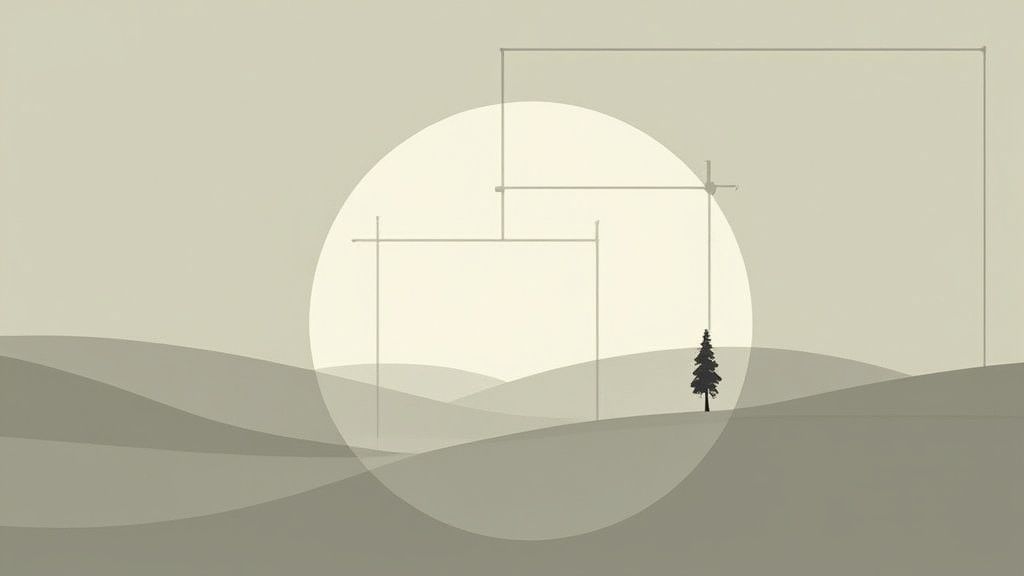
This method works because it forces the viewer's eye to move around the frame, creating a sense of energy and interest. A centered subject can feel static, but placing it off-center according to the Rule of Thirds adds visual tension and sophistication. For a deeper dive into foundational principles, you can explore more on how to make photos look professional.
How to Apply It
- Activate Your Grid: Most modern cameras and smartphones have a grid overlay feature in their settings. Turn this on to see the 3x3 grid in real-time as you compose your shot.
- Position Your Subject: Place your primary subject on one of the vertical lines or, for maximum impact, at an intersection point. For instance, in a portrait, align your subject's dominant eye with a top intersection.
- Balance the Horizon: When shooting landscapes, avoid placing the horizon in the dead center. Position it along the top third to emphasize the foreground or along the bottom third to highlight a dramatic sky.
Quick Tip for Portraits & Anime Avatars
For a compelling portrait ready for an AnimePhoto.ai transformation, place your subject's body along the left or right vertical line and their eyes on the upper horizontal line. This draws immediate attention to their expression while creating a pleasing, balanced aesthetic that translates perfectly into an animated style.
2. Leading Lines
Leading Lines are a powerful composition photography technique that uses natural or human-made lines to guide the viewer's eye through an image, often directly toward the main subject. These lines, which can be anything from roads and rivers to fences and shadows, create a clear visual path, adding a sense of depth, movement, and narrative to your photograph. They essentially act as arrows, telling the audience where to look and connecting different elements within the frame.

This method is incredibly effective for turning a flat, two-dimensional image into a dynamic, three-dimensional scene. By pulling the viewer into the photograph along a distinct pathway, you create an immersive experience that is more engaging and memorable. The lines establish a strong structural foundation that makes the composition feel deliberate and well-organized.
How to Apply It
- Identify Your Lines: Before shooting, scan your environment for potential leading lines. Look for roads, pathways, architectural edges, fences, streams, or even the direction of shadows.
- Position Your Subject: Place your point of interest at the end of the line or at a key intersection point along it. This gives the line a purpose and creates a strong focal point.
- Vary Your Angle: Don't just shoot from eye level. Get low to the ground to exaggerate the perspective of a road or path, making it appear more dramatic as it recedes into the distance.
Quick Tip for Portraits & Anime Avatars
When taking a portrait or selfie for an AnimePhoto.ai transformation, position yourself next to a strong linear element like a railing, a wall's edge, or a pathway. Have the line enter from a corner of the frame and lead toward you. This technique will draw all the attention to your face, creating a dynamic and professional-looking shot that translates beautifully into a captivating anime avatar.
3. Framing
Framing is a powerful composition photography technique that uses elements within the scene to create a natural "frame within a frame" around your main subject. Instead of an actual picture frame, you might use tree branches, a doorway, a window, or an archway. This clever method directs the viewer's eye directly to the focal point, adding a sense of depth and context to the image.
This layering technique is effective because it isolates your subject from a potentially distracting background, making the composition feel more intentional and organized. By placing something in the foreground, you create a stronger three-dimensional feel, inviting the viewer deeper into the scene. It’s a classic way to add sophistication and a narrative element to your photography.
How to Apply It
- Scout for Frames: Actively look for natural or architectural elements you can shoot through. Look for windows, arches, tunnels, dense foliage, or even gaps between people in a crowd.
- Create Depth: Position yourself so the framing element is in the foreground. You can choose to have both the frame and the subject in focus or use a shallow depth of field to blur the frame, which helps emphasize the subject even more.
- Balance the Composition: Ensure the framing element complements the subject rather than overpowering it. The frame should guide the eye, not steal the show. Consider how its lines, colors, and textures interact with your main point of interest.
Quick Tip for Portraits & Anime Avatars
When taking a portrait for an AnimePhoto.ai creation, use a window or a doorway as your frame. Have the subject stand just inside or outside of it. This not only adds beautiful depth and context but also often provides excellent natural lighting, which results in a clean, well-defined portrait that translates perfectly into a stunning anime-style avatar with a clear focal point.
4. Depth of Field and Layering
Depth of field is a powerful composition photography technique that adds a sense of three-dimensionality to a two-dimensional image. It involves controlling your camera's aperture to manipulate focus, creating distinct layers within your frame: the foreground, the subject, and the background. By intentionally blurring or sharpening these layers, you can guide the viewer's eye and establish a clear visual hierarchy.
A shallow depth of field, often characterized by a creamy, blurred background (bokeh), makes your subject pop, isolating them from any distracting surroundings. Conversely, a deep depth of field keeps everything from the nearest foreground element to the distant horizon in sharp focus, perfect for immersive landscapes. Understanding how to manage this can dramatically elevate your images. For a detailed guide on achieving this effect, you can explore more about how to blur a background in photos.

How to Apply It
- For Shallow Depth (Blurred Background): Use a wide aperture (a low f-number like f/1.8 or f/2.8). This narrows the plane of focus, making it ideal for portraits where you want the subject to be the sole point of attention.
- For Deep Depth (Sharp Everywhere): Use a narrow aperture (a high f-number like f/11 or f/16). This expands the plane of focus, ensuring maximum detail throughout the scene, which is essential for sweeping landscape shots.
- Create Physical Layers: Don't just rely on aperture. Physically place elements at different distances from your lens. Shoot through leaves in the foreground or frame your subject with an archway to enhance the feeling of depth.
Quick Tip for Portraits & Anime Avatars
To create a striking portrait ready for an AnimePhoto.ai transformation, use a wide aperture to blur the background completely. Position your subject so they are the only sharp element in the frame. This draws all attention to their face and expression, creating a clean, professional look that converts beautifully into a vibrant, focused anime avatar where the character is the undisputed star.
5. Symmetry and Patterns
Leveraging symmetry and patterns is a composition photography technique that creates a sense of harmony, order, and visual satisfaction. The human brain is naturally drawn to balance and repetition, making this method incredibly powerful. This technique involves finding or creating scenes where elements are mirrored or repeated, resulting in compositions that feel deliberate, stable, and impactful.
Symmetry can be found everywhere, from grand architectural facades to the perfect reflection of a mountain in a still lake. Patterns, whether geometric or organic, add rhythm and texture to an image, guiding the viewer's eye through the frame. Using this technique can transform an ordinary scene into a captivating piece of art by highlighting its inherent structure and beauty.
How to Apply It
- Find Your Center: For perfect symmetry, position yourself directly in the middle of your subject. Any deviation can disrupt the balance, so take your time to find the exact central point.
- Use Reflections: Still bodies of water are your best friend for creating natural symmetry. Puddles after a rainstorm, calm lakes, or even reflective surfaces like windows and polished floors can create stunning mirrored images.
- Break the Pattern: While a perfect pattern is pleasing, introducing a single element that breaks the repetition can create a powerful focal point and add a layer of narrative interest to your photograph.
Quick Tip for Portraits & Anime Avatars
For a bold and striking portrait, place your subject dead center in the frame, facing the camera directly. This creates a strong symmetrical composition that exudes confidence and directness. When converted with AnimePhoto.ai, this symmetrical framing results in a powerful, iconic anime avatar that grabs attention and feels perfectly balanced.
6. Negative Space
Negative space is one of the most powerful and sophisticated composition photography techniques, focusing on the empty or unoccupied area surrounding your main subject. Often called 'white space', this area is intentionally left simple to create breathing room, draw the viewer's eye directly to the subject, and evoke a sense of calm, isolation, or elegance. By embracing what isn't there, you give what is there incredible prominence.

This minimalist approach works by reducing visual clutter and distraction, forcing the brain to focus on the single most important element in the frame. A simple background, like a clear sky, a plain wall, or a calm body of water, allows the subject's shape, texture, and story to stand out dramatically. This technique adds a layer of artistic intent, transforming a simple snapshot into a deliberate, impactful statement.
How to Apply It
- Seek Simplicity: Find backgrounds that are uniform in color and texture. A cloudless sky, an empty field, or a solid-colored studio backdrop are perfect for creating effective negative space.
- Position with Purpose: Place your subject off-center, often following the Rule of Thirds. This placement enhances the feeling of emptiness and provides a visual path for the eye to follow toward the subject.
- Embrace 'Emptiness': Don't be afraid of large, seemingly empty sections in your frame. This space is not wasted; it's an active compositional element that defines your subject and sets the mood. Leave space in the direction your subject is looking or moving.
Quick Tip for Portraits & Anime Avatars
For a striking and modern portrait perfect for an AnimePhoto.ai conversion, photograph yourself against a simple, uncluttered wall or a wide-open sky. Position yourself on one side of the frame, leaving the other two-thirds of the image as clean negative space. This minimalist composition creates a high-impact, artistic feel that translates beautifully into a focused and stylish anime portrait.
7. Diagonal Composition
Diagonal Composition is one of the most effective composition photography techniques for injecting energy and movement into a static image. Instead of relying on stable horizontal or vertical lines, this method arranges key elements along diagonal axes. These lines guide the viewer's eye across the frame from corner to corner, creating a sense of dynamic tension, depth, and implied motion that is inherently more engaging.
This technique breaks the stability of the frame, making it perfect for action, sports, or architectural photography where you want to convey a feeling of progression or power. By tilting your perspective or finding natural diagonals like a winding road, a leaning tree, or a mountain ridge, you create a pathway for the viewer's gaze to follow, making the scene feel alive and three-dimensional.
How to Apply It
- Look for Natural Diagonals: Train your eye to spot diagonal lines in your environment. These can be roads, fences, shadows, rivers, or the lines of a building.
- Tilt Your Camera: A simple and effective way to create diagonals is to intentionally tilt your camera. This "Dutch angle" can turn an ordinary scene into a dramatic and disorienting composition.
- Use Leading Lines: Employ diagonal lines as leading lines to guide the eye toward your main subject, pulling the viewer deeper into the image and strengthening the visual narrative.
Quick Tip for Portraits & Anime Avatars
For a dynamic and action-oriented portrait, position your subject so their body forms a strong diagonal line across the frame. Have them lean into the shot or capture them mid-motion. This creates a powerful sense of energy that translates exceptionally well into an anime style, making your AnimePhoto.ai avatar look like it's leaping right out of the screen.
8. Color Theory and Harmony
Color Theory is a powerful composition photography technique that uses the relationships between colors to evoke emotion, create visual harmony, and guide the viewer's eye. Rather than just capturing what's there, this approach involves intentionally selecting and arranging colors within the frame to build a specific mood and strengthen the overall image. Understanding concepts like complementary, analogous, and monochromatic color schemes can transform a good photo into an unforgettable one.
Using color strategically creates visual impact that resonates on a subconscious level. Complementary colors, like orange and blue, generate high contrast and energy, making subjects pop. Analogous colors, such as shades of green and yellow, produce a more serene and unified feeling. This deliberate use of color adds a layer of sophistication and storytelling to your work. Mastering color can be enhanced with the right editing skills; you can explore advanced photo editing techniques to bring your color visions to life.
How to Apply It
- Complementary Contrast: Find scenes where opposite colors on the color wheel are present. Think of a bright orange sunset over a deep blue ocean or a person in a red coat standing in a green forest.
- Analogous Harmony: Look for subjects where adjacent colors on the wheel dominate. This is common in nature, like the various greens and yellows in a sunlit meadow or the reds, oranges, and yellows of autumn leaves.
- Monochromatic Focus: Create a composition using different tones and shades of a single color. This minimalist approach draws attention to texture, shape, and light.
Quick Tip for Portraits & Anime Avatars
To create a striking portrait for an AnimePhoto.ai conversion, place your subject against a background of a complementary color. For example, have them wear a blue shirt against a warm, orange-toned wall. This high-contrast color scheme will make the subject stand out dramatically, translating into a vibrant and eye-catching anime avatar with a powerful visual palette.
9. Point of View and Perspective
Changing your point of view is one of the most transformative composition photography techniques you can use to alter a scene's mood and narrative. Instead of shooting from a standard eye-level, this technique involves deliberately choosing a high, low, or angled camera position to create a unique visual impact. Your perspective dramatically influences how a viewer perceives the subject, turning an ordinary scene into something compelling and dynamic.
This method works by breaking the viewer's expectations and offering a fresh look at a familiar subject. A low angle can make a subject appear powerful and dominant, while a high angle can make them seem small or vulnerable. It's a powerful storytelling tool that controls the emotional context of your image, moving beyond simply documenting a scene to actively interpreting it.
How to Apply It
- Go Low (Worm's-Eye View): Get down on the ground and shoot upwards. This is excellent for emphasizing the height and scale of your subject, whether it’s a towering skyscraper or a person you want to portray as heroic and larger-than-life.
- Go High (Bird's-Eye View): Find a vantage point above your subject and shoot down. This perspective is great for showing patterns, simplifying a busy scene, or creating a sense of scale and context, often used in food and flat-lay photography.
- Experiment with Angles: Don't just move up and down. Move around your subject, shoot through objects in the foreground, or try a Dutch angle (tilting the camera) to add a feeling of unease or dynamic energy.
Quick Tip for Portraits & Anime Avatars
For a powerful anime avatar, try a slightly low-angle shot. Position the camera just below your eye level and angle it slightly upward. This subtle shift in perspective adds a sense of confidence and presence to your portrait. This angle is particularly effective for AnimePhoto.ai, as it can be exaggerated in the anime style to create a classic, heroic character look that stands out.
10. Visual Balance and Weight
Visual Balance and Weight is a fundamental composition photography technique that involves arranging elements to achieve a sense of equilibrium within the frame. Every object in your photo, from a person to a color patch, carries a certain "visual weight" determined by its size, color, contrast, and placement. By strategically distributing this weight, you can create a composition that feels stable and harmonious or intentionally imbalanced for a more dynamic, tense effect.
This method works by satisfying our innate desire for order and equilibrium. A balanced photo feels complete and pleasing, guiding the viewer's eye smoothly through the scene. An asymmetrically balanced image, where a large, heavy element is offset by several smaller ones, creates a more sophisticated and engaging visual journey. This is a core principle for creating professional-looking, impactful photographs.
How to Apply It
- Assess Visual Weight: Identify the "heaviest" elements in your frame. Large, dark, or brightly colored objects typically carry more weight than small, light, or muted ones.
- Create Symmetrical Balance: For a formal, stable, and peaceful mood, place elements of equal weight on opposite sides of the frame's central axis. This is often used in architecture or landscape reflections.
- Use Asymmetrical Balance: For a more dynamic feel, place your main subject off-center and balance its weight with a smaller, less significant element in the opposing space. For example, a person on the right can be balanced by a distant mountain on the left.
Quick Tip for Portraits & Anime Avatars
When creating a portrait for an AnimePhoto.ai transformation, use asymmetrical balance for a dynamic look. Place your subject on one side of the frame and use a background element, like a window or a plant, on the other side to balance the composition. This adds depth and context, which translates beautifully into a rich, engaging anime-style image.
10 Composition Techniques Comparison
| Technique | 🔄 Implementation Complexity | ⚡ Resource Requirements & Efficiency | 📊 Expected Outcomes (⭐ effectiveness) | 💡 Ideal Use Cases | ⭐ Key Advantages |
|---|---|---|---|---|---|
| Rule of Thirds | Low — simple grid guidance | Minimal — camera/grid overlay; very quick to apply | ⭐⭐⭐ — Balanced, engaging compositions | Landscapes, portraits, travel, everyday shots | Quick to learn; versatile; reduces center monotony |
| Leading Lines | Medium — requires scene observation & placement | Minimal gear; may need scouting for strong lines; moderate speed | ⭐⭐⭐⭐ — Strong depth and guided visual flow | Roads, rivers, architecture, environmental portraits | Directs viewer eye; adds depth and movement |
| Framing | Medium — careful positioning and focus control | Little gear; uses foreground elements; planning improves results | ⭐⭐⭐⭐ — Isolates subject and adds contextual depth | Portraits, travel, interiors, wildlife | Emphasizes subject; adds narrative/context |
| Depth of Field & Layering | Medium–High — aperture and focus precision | Fast lenses, ND filters, tripod; technical knowledge needed | ⭐⭐⭐⭐⭐ — Powerful subject isolation or detailed layered scenes | Portraits (bokeh), macro, layered landscapes | Strong control of emphasis; enhances three-dimensionality |
| Symmetry & Patterns | Medium — precise alignment and vantage choice | Minimal gear; tripod helps for exact symmetry; moderate time | ⭐⭐⭐⭐ — Visually satisfying, memorable images | Architecture, aerial, reflections, abstract compositions | Immediate harmony; strong graphic impact |
| Negative Space | Low–Medium — requires compositional restraint | Clean backgrounds or selective framing; efficient once found | ⭐⭐⭐ — Clean, minimalist impact with strong focus | Minimalist portraits, product, expansive landscapes | Eliminates clutter; highlights subject; evokes mood |
| Diagonal Composition | Medium — balancing dynamic elements | No special gear; may require camera tilt or movement | ⭐⭐⭐⭐ — Dynamic, energetic, tension-filled images | Sports, action, dynamic landscapes, architecture | Conveys motion; creates engaging flow |
| Color Theory & Harmony | Medium–High — color knowledge and control | Color planning, location scouting, post-processing skills | ⭐⭐⭐⭐⭐ — High emotional and visual impact | Fashion, commercial, editorial, vivid landscapes | Controls mood; creates distinctive, memorable imagery |
| Point of View & Perspective | Medium — creative experimentation & repositioning | Ladders, drones, wide/macro lenses; time to explore | ⭐⭐⭐⭐ — Fresh viewpoints and strong storytelling | Aerial, macro, street, editorial, dramatic portraits | Transforms ordinary scenes; strong narrative power |
| Visual Balance & Weight | High — nuanced arrangement and judgment | Styling, props, time, possible assistants for setup | ⭐⭐⭐⭐ — Psychologically satisfying or intentionally tense | Still life, group portraits, advertising, editorial | Conveys stability or tension; refines compositional quality |
From Theory to Practice: Start Composing Your Masterpiece
You’ve just explored ten foundational composition photography techniques that are the building blocks of visually compelling images. From the balanced asymmetry of the Rule of Thirds to the immersive quality of Framing and Layering, each principle offers a unique tool for guiding your viewer's eye and telling a more effective story. We’ve covered how Leading Lines create pathways, how Symmetry and Patterns bring order, and how Negative Space gives your subject room to breathe.
The journey from knowing these rules to mastering them is paved with practice. The goal is not to rigidly follow a checklist for every shot, but to internalize these concepts so they become a natural, intuitive part of your creative process. Think of these techniques as a language. Initially, you focus on individual words and grammar, but with time, you begin to form fluid, expressive sentences without conscious effort. Your photography will evolve in the same way.
Your Actionable Path Forward
To truly integrate these skills, you need to move from passive reading to active creation. Here are your next steps:
- Choose a Focus Technique: On your next photo session, whether it's with your phone or a DSLR, pick just one or two techniques to focus on. Spend an hour dedicated solely to finding leading lines or creating depth. This focused practice is far more effective than trying to apply all ten rules at once.
- Activate Your Grid: The single most impactful setting you can enable on your camera or smartphone is the grid overlay. It keeps the Rule of Thirds and visual balance top of mind until it becomes second nature.
- Analyze and Learn: Don't just look at photos you admire; deconstruct them. Identify the compositional techniques at play. Ask yourself why the photographer placed the subject there or chose that specific angle. This reverse-engineering will sharpen your eye exponentially.
- Break the Rules with Intention: Once you understand why a rule works, you'll know exactly when and how to break it for maximum impact. A perfectly centered subject can be incredibly powerful, but its power comes from defying the expected Rule of Thirds composition.
Mastering these composition photography techniques is about taking control of your narrative. It's the difference between merely documenting a scene and interpreting it. These principles are not just for static images; they are fundamental to all visual media. To further broaden your understanding of visual storytelling and its modern applications, you can also explore how these compositional principles translate to trending visual content like short-form videos, where every second of engagement counts.
By consciously applying, experimenting, and even breaking these rules, you will develop a distinct visual signature. Your images will not only look better, they will feel more intentional, professional, and resonant. Now, take these tools, go out into the world, and start composing with confidence.
Ready to see your perfectly composed photos in a new light? Take your best shots and transform them into unique, personalized art with AnimePhoto.ai. Our advanced AI honors your original composition while reimagining your portraits, pet photos, and group shots in vibrant anime styles. Try it now at AnimePhoto.ai and give your images a creative twist

See yourself in anime style in under a minute
Pick a style, upload a photo, and get a high-quality anime portrait ready for profiles, prints and gifts.
Create your anime photo