When people ask me what the "best" lighting for portraits is, my answer is always the same: soft, diffused light. It’s not about having the most expensive gear; it’s about the quality of the light itself. This kind of light minimizes harsh shadows, makes skin tones look incredible, and gives your photos that professional, three-dimensional pop.
Picture the gentle glow coming from a large window on an overcast day. Now contrast that with the sharp, unflattering shadows you get from direct midday sun. That’s the difference we’re talking about.
Understanding the Foundation of Great Portraits
Before we get into specific setups, let’s nail down the one core principle that truly separates a quick snapshot from a professional portrait: the difference between hard and soft light.
This single concept is the secret sauce to making your subjects look their absolute best, whether you're shooting with a top-of-the-line DSLR or just your phone. Once you really get this, every other technique in this guide will click into place.
Hard Light vs. Soft Light
So, what’s the actual difference? It all comes down to the size of the light source relative to your subject.
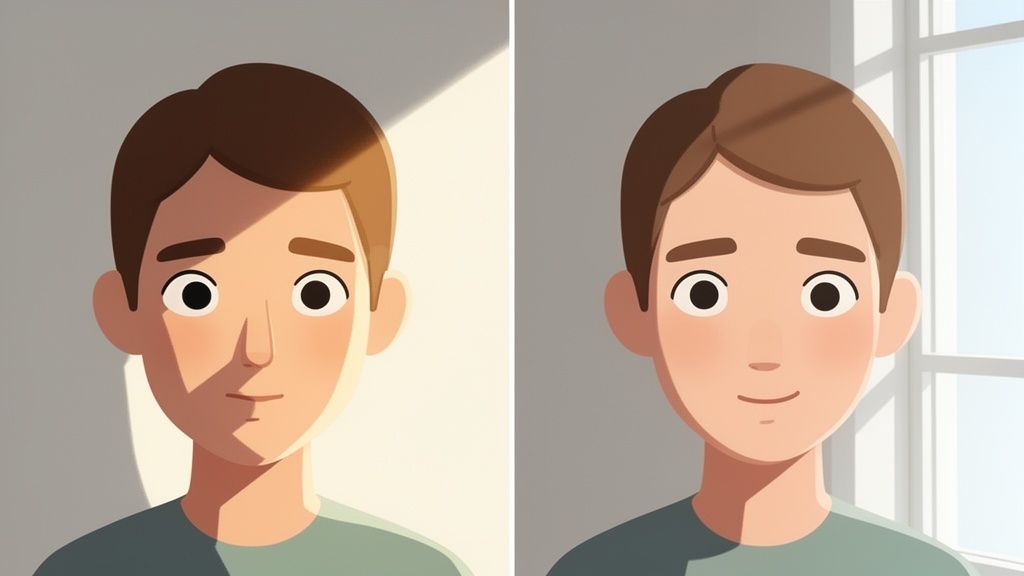
Hard light comes from a small, direct source. Think of a bare lightbulb without a shade or the sun on a cloudless day. It creates crisp, well-defined shadows that can highlight every skin texture and create a very intense, dramatic feel. While it has its place in certain creative styles, it's generally unflattering for classic portraits because it often casts dark, distracting shadows under the eyes and nose.
Soft light is the complete opposite. It comes from a large, diffused source that wraps gently around your subject. This could be the light from a huge north-facing window, a sky blanketed in clouds, or a studio flash fired through a softbox. The result is soft, gentle shadows with beautiful, smooth transitions from light to dark.
Key Takeaway: For flattering portraits, always aim for soft light. It smooths skin, reduces harsh shadows, and creates a much more pleasing and natural appearance. This is your starting point for achieving that professional look.
Of course, the quality of light isn't just about softness. Another critical piece of the puzzle is how different light sources affect the color in your photo. The warmth or coolness of a light, known as its color temperature, can completely change the mood and how skin tones are rendered. For a deeper look, this guide on understanding color temperature in lighting is a fantastic resource for getting your colors right in-camera.
Mastering soft light and managing color gives you control over the two most important elements of great portraiture.
Using Natural Light for Flawless Portraits
If there's one secret weapon in a portrait photographer's toolkit, it's natural light. It’s free, it’s everywhere, and it has a way of rendering skin tones with a soft, organic quality that studio strobes can only try to imitate. Honestly, mastering it has less to do with fancy gear and everything to do with learning to see the light that’s already there.
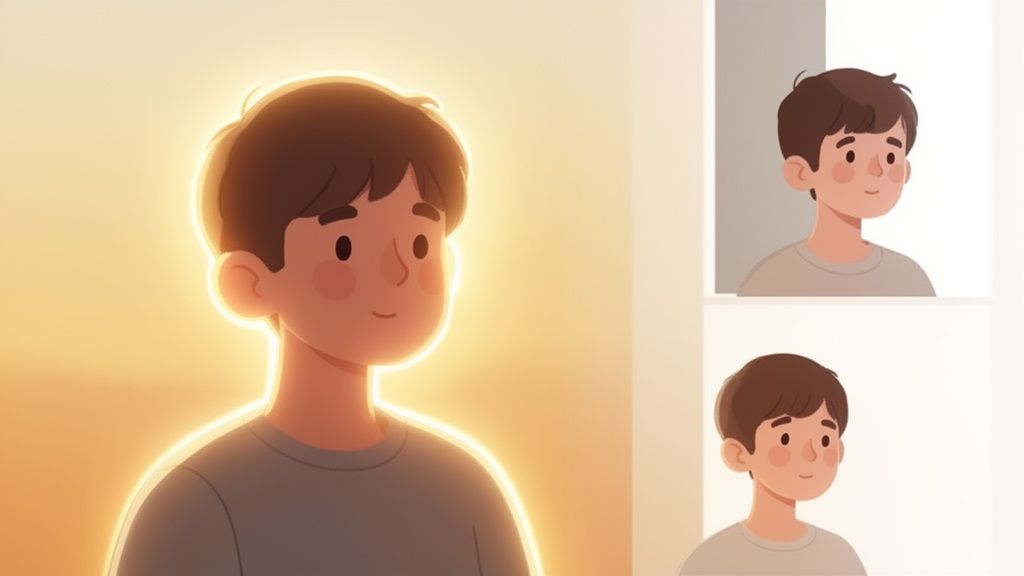
You’ve probably heard photographers rave about the “golden hour.” There’s a good reason for it. That magical window of time just after sunrise or right before sunset gives you the most incredible light to work with. The sun is low in the sky, so the light is warm, soft, and directional, creating these beautiful long shadows and a dreamy glow that’s ridiculously flattering. Think of the low-hanging sun as a giant, free softbox.
Pro Tip: Try this classic golden hour technique next time you're out. Place your subject so the sun is behind them. This creates a gorgeous rim light around their hair and shoulders, making them pop from the background. You'll then need to bring some light back onto their face—either by using a reflector or just by exposing for their face, which might slightly overexpose the background for a beautiful, airy feel.
Harnessing Open Shade and Window Light
But here’s the thing: you don't have to wait all day for a perfect sunset. Some of my absolute favorite portraits were shot in what’s called open shade. This is simply any spot that’s out of direct sun but still lit by the open sky—think the side of a building, under a big leafy tree, or inside a covered porch.
On a bright, sunny afternoon, direct sunlight is your enemy. It creates harsh, raccoon-like shadows under the eyes and makes people squint. Open shade solves that problem completely. The bright sky acts as a massive, diffused light source, giving you beautiful, even light without any of the harshness. It’s my go-to for clean, professional portraits, no matter the time of day.
When you’re shooting indoors, a large window is your best friend. The light streaming through a window is naturally soft and directional, giving you a look that can easily mimic a high-end studio setup. For that timeless, painterly vibe, these two setups are all you really need:
- Facing the Light: Have your subject look directly toward a large window. This bathes their face in bright, even light, minimizing shadows and creating a really clean, fresh look. It's perfect for headshots.
- Side Lighting: Position your subject at a 45-degree angle to the window. This is where the magic happens. You’ll get soft shadows that gently sculpt their facial features, adding depth and dimension. This is one of the most universally flattering lighting angles out there.
Simple Tools to Shape Natural Light
Even the best light can be made better with a few simple tools. And no, you don't need to spend a ton of money on professional gear.
Grab a piece of white foam core from a craft store, or even just a large white t-shirt in a pinch. This is now your reflector. When your subject is lit by a window, hold the foam core on the opposite side of their face, just out of frame. You’ll see it instantly bounce that soft window light back, filling in the shadows for a brighter, more balanced photo.
This one simple trick is what gives images that polished, professional look. It’s all about managing contrast and making sure your subject’s features are lit beautifully. Once you get the hang of bouncing and redirecting sunlight, you'll feel like you have complete control over the final image.
Building a Simple Home Studio with Artificial Light
When the sun goes down or you're stuck with a gloomy, overcast day, artificial light becomes your best friend. It gives you the power to create consistent, repeatable, and stunning portraits any time you want. You don't need a sprawling, expensive studio to get professional results, either—setting up a simple home studio is easier and more affordable than you might think.
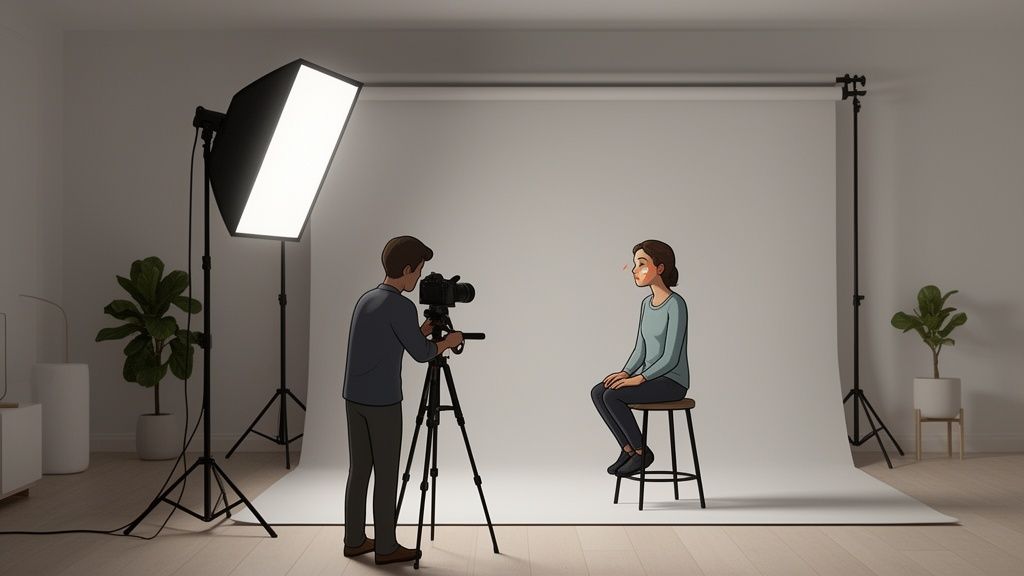
The conversation about the best lighting for portrait photography has moved way beyond traditional studios. A lot of the demand for accessible lighting is actually driven by the creator economy. The global photography services market, which was valued at around $12.6 billion in 2023, is being completely reshaped by content creators who need reliable, flattering light on demand.
Your First Artificial Light Source
If you're just starting out, the world of strobes and flashes can feel a little overwhelming. That's exactly why I recommend beginners start with modern LED panels. They're "continuous" lights, which is just a fancy way of saying they stay on. What you see is what you get, making it incredibly easy to watch how the shadows fall across your subject as you move the light around.
Modern LEDs have some serious perks:
- Adjustable Brightness: You can crank the intensity up or dial it down with a simple knob, no need to physically move the light stand.
- Variable Color Temperature: Many models let you shift the light from a warm, sunset-like glow to a cool, daylight-like white to perfectly match the mood you're going for.
- Low Heat Output: Unlike the old-school tungsten lights that could cook an egg, LEDs stay cool to the touch. This keeps your subject comfortable, especially during longer shoots.
Ring lights are another hugely popular choice, especially for headshots and video content. They create a very direct, even light that wraps around the face and blasts away shadows, giving you a clean, modern look. It's a fantastic option if you're looking for a simple way to take your own professional headshots. Find out more at: https://animephoto.ai/blog/how-to-take-your-own-headshots
Classic One-Light Portrait Setups
You can create portraits with incredible depth and character without a complicated, multi-light system. In fact, a single light, when positioned thoughtfully, can produce some of the most stunning and timeless results. Here are two classic setups to get you started.
Rembrandt Lighting
This dramatic style gets its name from the legendary painter who mastered it. You'll know it by the small, isolated triangle of light that appears on the cheek opposite the main light source.
To get this look, place your light high and to one side of your subject, roughly at a 45-degree angle. Tweak the height and angle until you see that signature triangle form just under their eye. It’s a powerful technique for injecting a serious dose of mood and drama into a portrait.
Pro Tip: If you remember one thing about artificial light, make it this: diffusion is everything. Never point a bare bulb at someone. Your light needs a softbox, an umbrella, or even a white bedsheet safely draped in front of it. This softens and spreads the light, making it behave more like the gentle light from a large window.
Loop Lighting
This is one of the most common and universally flattering lighting setups out there. It’s not quite as dramatic as Rembrandt, but it still carves out the face and adds beautiful dimension.
Position your light slightly above eye level and about 30-45 degrees off to the side of the camera. This creates a small, "loop-shaped" shadow from your subject's nose that points down toward the corner of their mouth. It’s a true workhorse setup that looks great on almost any face shape. For anyone piecing together a temporary studio, understanding a basic photo booth lighting setup can offer some great transferable knowledge for positioning artificial lights.
Dialing in Your Camera Settings for Any Light
Even the most perfect light won't save a photo if your camera isn't set up to capture it correctly. Getting your settings right is the other half of the equation, the technical side that turns a great lighting setup into an absolutely stunning final image. This is how you tell the camera exactly what you want it to see.
At the core of it all is the exposure triangle: a constant balancing act between Aperture, Shutter Speed, and ISO. I like to think of them as three interconnected dials. Tweak one, and you'll likely need to adjust another to get the brightness and creative feel you're after. Once you get them working in harmony, you're in complete control.
Mastering the Exposure Triangle
First, let's talk about Aperture. This setting controls the size of the opening in your lens, and for portraits, it's your secret weapon for creating that gorgeous, blurry background that makes your subject stand out. A wide aperture—which means a low f-stop number like f/1.8 or f/2.8—creates that shallow depth of field, instantly isolating your subject from any distracting background elements.
Next up is Shutter Speed, which is simply how long the camera's sensor is exposed to light. For portraits where your subject is relatively still, a shutter speed of at least 1/125s is a good, safe starting point to prevent blur from your own hand movements. If you're photographing an energetic kid or someone who can't sit still, you'll want to bump that up to 1/250s or even faster to freeze the motion.
Finally, we have ISO, which dictates your camera's sensitivity to light. Your goal should always be to keep this as low as you possibly can—ideally 100 or 200—to get the cleanest, most detailed image. Of course, when the light gets dim, you have no choice but to increase it. Just be aware that pushing the ISO too high can introduce a grainy texture called digital noise. If that happens, our guide on how to reduce noise in photos has some great tips to clean things up.
Getting Skin Tones Just Right
Beyond just brightness, getting the color right is non-negotiable, especially for skin tones. This is where White Balance becomes your best friend. While leaving it on "Auto" works surprisingly well most of the time, different light sources have different color temperatures. Sunlight is cool and blueish, while the lamp in your living room is warm and orange.
To get more consistent, natural-looking skin, try switching to a preset like "Cloudy" or "Shade." This gives you far more control and prevents your subject from looking too orange or too blue.
Smartphone Tip: Don't forget you have manual control, too! Tap and hold on your subject's face on the screen. This will lock both the focus and the exposure on them, which is a lifesaver if the background light is changing or you're moving around.
This need for precise control is exactly why so many photographers invest in good lighting gear. The explosion of LED technology, which now dominates the market, has made professional-level lighting more accessible than ever. Modern LEDs offer adjustable color temperatures, letting you dial in anything from warm golden hour light to crisp, neutral daylight on command. It’s a huge reason the photography lighting equipment market is expected to skyrocket to $65.3 billion by 2031.
Solving Common Portrait Lighting Problems
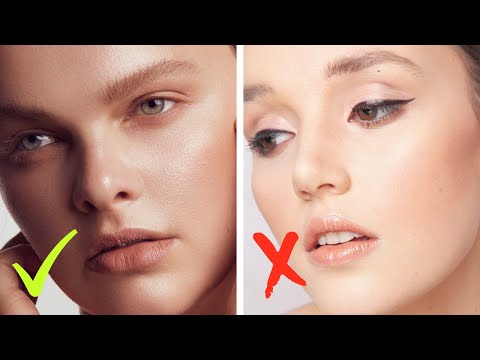
Even with the best planning, light has a mind of its own. Every photographer, no matter how experienced, hits a wall sometimes. A perfect shot can go south fast, but learning to fix these common problems in the moment is a crucial skill.
It’s like developing a sixth sense for light. Eventually, you start to anticipate issues before they even happen and know just what to do.
Eliminating Harsh Shadows and Raccoon Eyes
One of the most persistent pains in portrait photography is the dreaded "raccoon eyes." This happens when your main light source—usually the sun at high noon—is directly overhead. It creates deep, unflattering shadows under the eyes, nose, and chin. It's not a good look.
Thankfully, the fix is usually just about changing the light's direction relative to your subject.
- Find Open Shade: The easiest trick in the book. Move your subject under a tree, in the shadow of a building, or beneath an awning. The harsh sun instantly becomes a huge, soft, flattering light source.
- Use a Reflector: If you can't move your subject, grab a reflector. Even a simple piece of white poster board will do. Just bounce some of that light back up into their face to fill in those dark spots.
- Add Fill Flash: A quick pop of flash from your camera can also be a lifesaver. It brightens up the shadows just enough to create a much more balanced and pleasing exposure.
Key Insight: The problem is almost never "too much light," but light coming from the wrong direction. By changing the light's angle or softness, you take back control and shape the portrait exactly how you want it.
This decision tree gives you a great visual for how to think through your camera settings depending on the light you have.
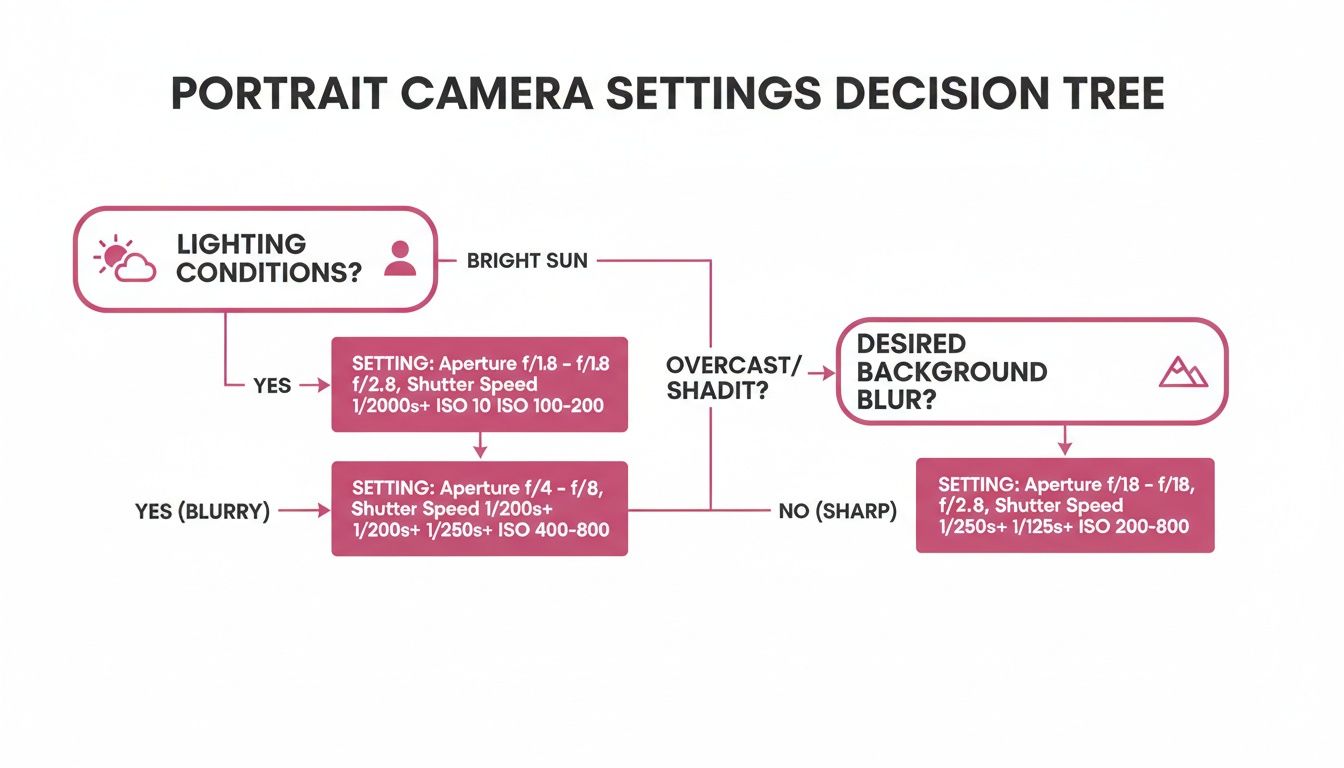
As you can see, everything starts with the quality of your light. That one factor dictates the best choices for your aperture, shutter speed, and ISO.
Dealing with Washed-Out Photos and Glare
Another classic problem is the washed-out, overexposed photo. This often happens when a really bright background, like a sunny sky, fools your camera's light meter. It tries to expose for the bright background, leaving your actual subject looking dark and muddy. For times when you can't fix it in-camera, our guide on how to fix overexposed photos has some great post-processing tips.
And for anyone wearing glasses, glare can be a total nightmare. Those distracting white reflections can completely hide your subject's eyes.
The solution is all in the angles. Ask your subject to tilt their head down slightly or turn a little bit away from the light. You can also try raising your light source higher, which angles the reflection downward and out of your shot. It’s a tiny adjustment that makes a massive impact.
Getting the light right matters. The global photography market hit $105.2 billion** in 2023, and the portrait segment alone was valued at around **$20.6 billion. It just goes to show how much people value a well-lit, flattering photo. You can dive deeper into these photography industry statistics to see where things are headed.
Answering Your Top Portrait Lighting Questions
When you're getting started with portrait photography, or even when you've been at it for a while, certain questions always seem to pop up. Let's tackle some of the most common lighting puzzles photographers face so you have clear answers ready for your next shoot.
What’s the Most Flattering Light Direction for a Portrait?
For almost any face, the magic formula is placing your light at a 45-degree angle to your subject and just a little above their eye level. This is the secret behind "loop lighting," named for the small loop-shaped shadow the nose casts toward the corner of the mouth.
Why is this angle so popular? Because it carves out the face, adding depth and dimension. It stops your photos from looking like flat, boring passport pictures, which is what happens with direct, head-on light. It also avoids the harsh, raccoon-like shadows you get when light comes straight down from above. Whether you’re using a fancy studio light or just a window, this is always your best starting point.
Can I Actually Use a Regular Lamp for Lighting?
Absolutely. You can definitely use a standard household lamp, but you can't just point it at someone and hope for the best. The trick is to soften that harsh light.
A bare bulb creates hard, sharp shadows that aren't very flattering. To fix this, you need to diffuse it. Try hanging a white bedsheet or taping some parchment paper a safe distance in front of the bulb. Even better, point the lamp at a white wall or ceiling and let that reflected light illuminate your subject. This technique makes your light source feel much bigger and softer, giving you a beautiful, gentle glow.
My Go-To Rule: The core principle is always to make your light source relatively bigger. Bouncing a tiny lamp off a huge white wall transforms a harsh spotlight into a massive, soft source that’s perfect for portraits.
How Do I Get Rid of Glare on Glasses?
Glare on glasses is a classic headache. It happens when your light source reflects off the lenses and straight into your camera. Thankfully, the fix is usually just a small adjustment of angles between your light, your subject, and your camera.
It rarely takes a big change to solve it. Here are a few things I always try first:
- Lift the Light: Move your light source higher. This pushes the reflection downward, out of your camera's line of sight.
- Change Their Pose: Ask your subject to turn their head just a tiny bit away from the light or to dip their chin down slightly.
- Tilt the Frames: Sometimes, just having them push their glasses down their nose a fraction of an inch is all it takes to kill the glare.
What's the Real Difference Between Hard and Soft Light?
It all comes down to the shadows. That's it.
Hard light comes from a small, direct source—think the sun on a cloudless day or a bare camera flash. It creates crisp, dark shadows with very defined edges. This look is dramatic and intense, emphasizing every little bit of texture on a person's skin.
Soft light, on the other hand, comes from a big, diffused source, like a cloudy sky or a flash shot through a softbox. The light wraps around your subject, creating gentle, soft-edged shadows. For most portraits, soft light is your best friend because it smooths out features and just looks more natural and pleasing.
Ready to see yourself in a totally new light? AnimePhoto.ai can take your perfectly lit portraits and transform them into stunning, share-worthy anime art. Upload your photo and discover a new style today.

See yourself in anime style in under a minute
Pick a style, upload a photo, and get a high-quality anime portrait ready for profiles, prints and gifts.
Create your anime photo