Creating your own chibi characters can go one of two ways: you can dive into the world of traditional drawing, or you can use a bit of modern magic with AI generation. At the heart of it all, though, are the same core principles: oversized heads, huge expressive eyes, and tiny, simplified bodies that give chibis their signature adorable look.
Your Quick Start Guide to Making Chibi Characters
Welcome to the wonderfully cute world of chibi art! It doesn’t matter if you’re a seasoned artist or have never picked up a pencil before; creating these charming, "super-deformed" characters is something anyone can get into. The whole point of the chibi style is to max out the cuteness and forget about realism, which is why it's so popular in everything from anime to sticker designs.
Before you start, you’ve got a choice to make. Are you going to roll up your sleeves and draw your chibi from scratch, or do you want the instant results that an AI tool can offer?
Choosing Your Creation Method
Going the traditional drawing route gives you total creative freedom. Every line, every color, every tiny detail is yours to control. This path is fantastic for artists who want to hone their skills and really pour their own personality into their work. You'll get familiar with the specific rules of chibi anatomy, like the classic 1:2 or 1:3 head-to-body ratio, and practice simplifying features to their cutest forms.
On the other hand, if you're after speed and simplicity, an AI generator like AnimePhoto.ai is your best bet. You don't need any drawing skills at all. Just upload a photo, and the tool will instantly whip up a polished chibi character for you.
Key Takeaway: The right method really boils down to what you're trying to achieve. Drawing offers deep customization and is a great way to build your artistic skills. AI gives you a quick, effortless way to get a high-quality chibi for a profile picture or a fun gift, with zero learning curve.
No matter which path you take, this guide will cover the essentials. We'll break down the key techniques for both drawing and AI, so you can bring your adorable character ideas to life.
Chibi Creation Methods Compared: Drawing vs. AI
So, should you sketch it out yourself or let an AI do the heavy lifting? Both have their perks. For many, the choice comes down to time, skill level, and how much control you want over the final piece. This table breaks down the key differences to help you decide which method is right for you.
| Feature | Traditional Drawing | AnimePhoto.ai (AI Generator) |
|---|---|---|
| Skill Required | Intermediate to advanced art skills needed for good results. | None. Perfect for beginners. |
| Time Commitment | Can take hours, depending on complexity and detail. | A few seconds to a minute. |
| Creative Control | 100% control over every detail, from pose to expression. | Limited to available styles and a text prompt. |
| Customization | Unlimited. Your imagination is the only limit. | High, but works within the AI's learned parameters. |
| Consistency | Can be challenging to maintain a consistent style across multiple pieces. | Excellent. Produces a consistent style every time. |
| Best For | Unique personal projects, skill development, professional commissions. | Profile pictures, avatars, gifts, and quick concepts. |
Ultimately, there's no "wrong" answer here. Many artists even use AI to quickly generate ideas or base concepts before diving into a more detailed drawing. The best approach is the one that gets you excited to create.
Mastering Chibi Proportions and Anatomy
If you really want to learn how to make chibi characters, you have to get a feel for their unique, super-cute anatomy. The first rule? Throw everything you know about realistic human proportions right out the window. We're chasing pure, condensed cuteness, and that means forgetting the standard 1:7 head-to-body ratio.
The most important guideline—the one that really defines the chibi look—is the head-to-body ratio. You're aiming for a character who is only two or three heads tall in total. That's it. So, if you draw a head, the entire character's height will only be two or three times that measurement. A 1:2 ratio gives you that extremely squished, adorable look, while a 1:3 ratio leaves a little more room for expressive poses.
Ever wonder where this style came from? The "Super Deformed" or SD style really took off in the 1980s. Manga legend Akira Toriyama's 1980 series 'Dr. Slump' was a huge influence, often featuring characters with a head-to-body ratio of about 1:3. It's a fun bit of manga history that shaped the chibis we love today.
Building the Chibi Body
Once you have the head size figured out, building the body is surprisingly straightforward. Your mantra should be "soft and round." Forget about defined muscles or complex skeletons.
- The Torso: I usually start with a simple bean, pear, or even an egg shape. The key is to keep it small—often just a bit larger than the head—to really sell that classic, top-heavy chibi silhouette.
- The Limbs: Think of the arms and legs as short, stubby little sausages. You want to avoid sharp, defined elbows and knees. Instead, use gentle curves to suggest the joints.
- Hands and Feet: Simplify, simplify, simplify! I often draw hands as simple mittens or paws with just a hint of a thumb. Feet can be even simpler: just small, rounded nubs. This keeps the visual focus right where you want it—on the character's expressive face and overall shape.
This process chart gives a great overview of the workflow, whether you're sketching by hand or using a tool to speed things up.
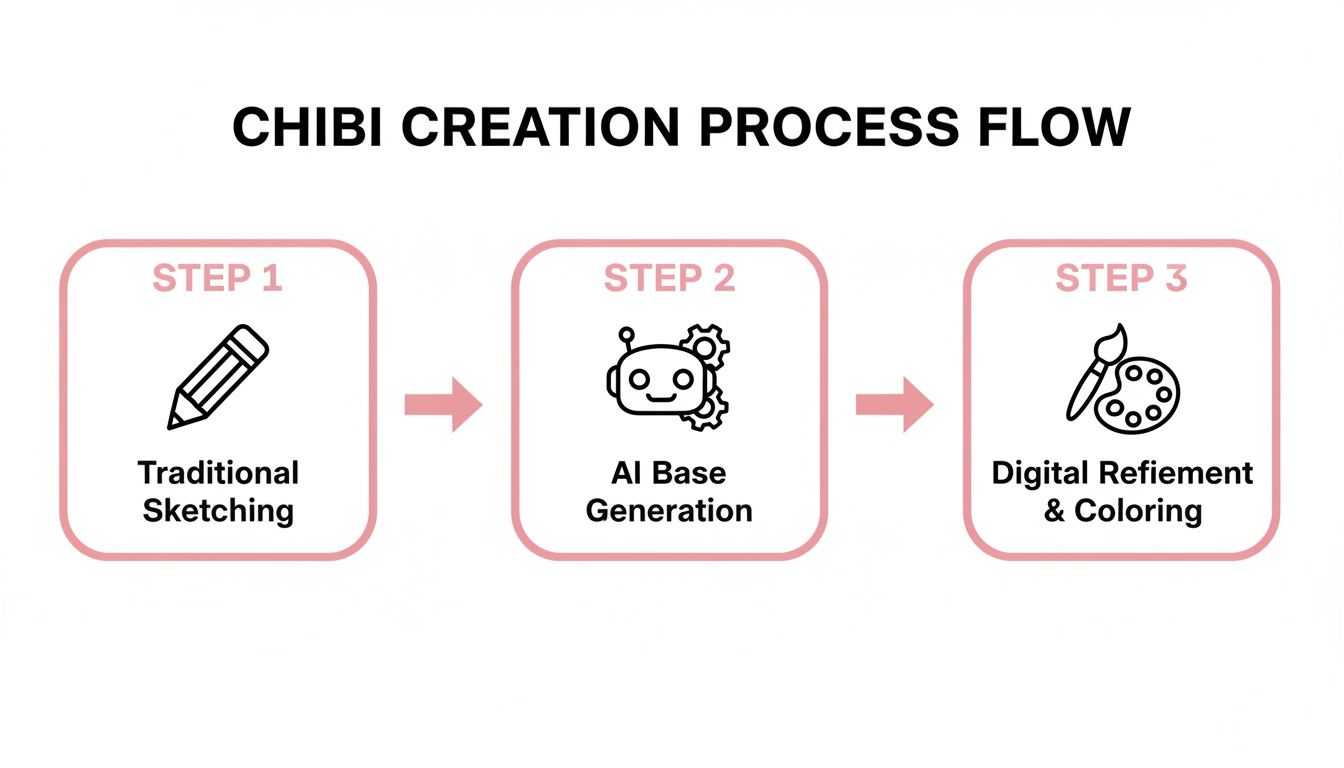
As you can see, no matter how you choose to bring your chibi to life, those core principles of proportion are always the starting point.
Creating a Basic Wireframe
Here’s a pro tip: to keep your chibis from looking flat or stiff, get into the habit of starting with a simple wireframe. I’m not talking about a complicated anatomical skeleton, either.
Just think of it as a stick figure built with those chibi proportions we just talked about. A big circle for the head, a smaller oval for the torso, and simple lines for the limbs are all you need. This quick sketch helps you nail down the pose, check the balance, and figure out how the character fits in their space before you get lost in the details. It’s a tiny step that breathes so much life and dynamism into the final piece. And if you're working digitally, exploring different anime character design software can give you some great tools to make this even faster.
Giving Your Chibi a Face Full of Personality
The real magic of a chibi character? It's all in the face. Sure, the tiny body and giant head give you that classic chibi look, but it's the face that tells the story and packs that emotional punch. If you want to master the art of making chibis, nailing the facial features is your top priority.
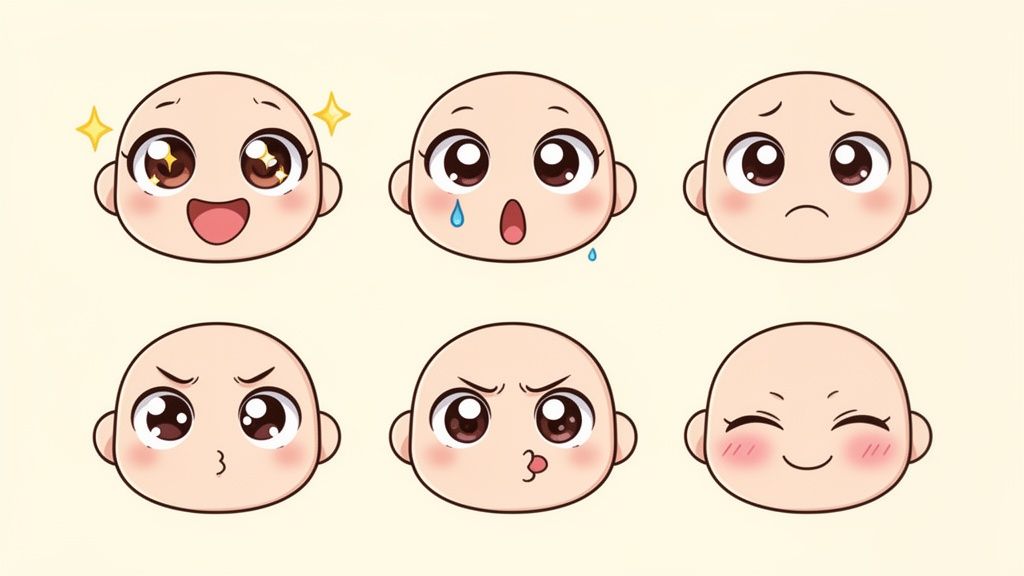
This is where exaggeration really gets to have fun, especially with the eyes. They aren’t just windows to the soul; for a chibi, they are the soul. Big, expressive eyes are your number one tool for showing off a character's personality and feelings, often taking up a huge chunk of the face—we're talking anywhere from 30% to 40% of the total real estate.
Where you place them matters, too. I've found that setting the eyes low on the face, usually below the horizontal centerline, is a simple trick that instantly amps up the youthful, childlike vibe that makes chibis so darn cute.
It's All in the Eyes
When it comes to the eyes themselves, you have a massive creative playground. Don't feel stuck with just one style; a simple change in the eyes can completely transform a character's whole mood.
- Dots and Lines: For a funny or super-simple character, you can't go wrong with dots or curved lines. It's a surprisingly effective way to show pure bliss or total shock.
- Classic Anime Orbs: This is the style most people think of—big, colorful, and full of life. These usually have a dark pupil, a vibrant iris (often with a cool color gradient), and a few white highlights to make them look shiny and gem-like.
- Unique Shapes: Who says eyes have to be round? Get creative! Try ovals, soft squares, or even stars to give your character a more fantastical or unique feel.
My Go-To Tip: I always think about drawing chibi eyes in layers. I start with the main shape, fill in the iris color, then pop in the pupil. The final touch that brings them to life is adding at least two highlights—a big main one and a smaller secondary one. It's a simple technique that creates incredible depth.
Keep the Rest of the Face Simple
With the eyes stealing the show, you need to simplify the other facial features. This isn't about being lazy; it's about making sure the face doesn't get cluttered, which allows the expressions to read clearly and immediately.
Take the nose, for example. It’s often just a tiny dot, a small dash, or a little triangle right between the eyes. Honestly, a lot of artists (myself included) sometimes leave it out completely in a front-on view to really lean into that flat, "kawaii" aesthetic.
The mouth is another powerful tool precisely because it’s so simple. A single curved line can show happiness or sadness. A small 'o' is instant surprise. For bigger emotions like rage or a belly laugh, an exaggerated, wide-open mouth does the trick perfectly. The beauty of it is that a few quick lines can create a huge emotional impact, letting you build a whole library of expressions with just minor tweaks.
Designing Adorable Outfits and Accessories
When it comes to chibi art, clothes aren't just clothes—they're a huge part of the character's charm and personality. The most important thing to remember is simplification. An intricate, hyper-detailed outfit that looks amazing on a full-sized anime character will just turn into a cluttered mess on a tiny chibi body. Your goal is to capture the vibe of the outfit, not every last stitch and buckle.
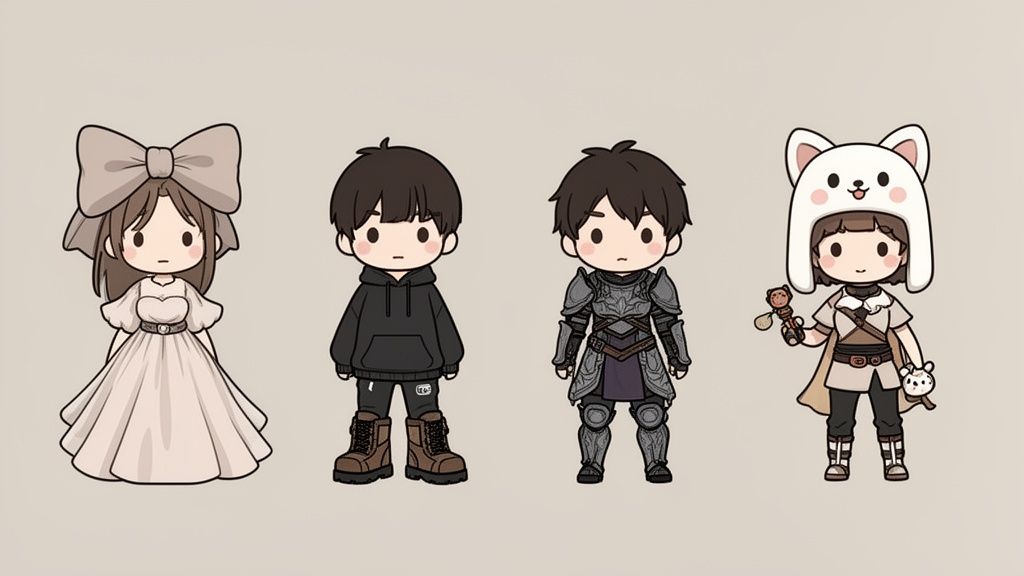
This "less is more" approach has been part of the style forever. Chibi art really took off worldwide with the anime boom of the 1990s. Think about shows like 'Sailor Moon' or 'Dragon Ball Z'—they constantly used super-deformed versions of their characters for gags and emotional beats. In fact, animation studies from that era show these chibi forms popped up in roughly 15-20% of episodes, all because their simple designs made the comedy hit that much harder.
Emphasizing Key Features
To really make your chibi's outfit stand out, pick one or two key elements and exaggerate them. This immediately draws the viewer's eye and injects a dose of personality without making the design feel too busy.
- Oversized Elements: A giant, floppy bow in their hair, a scarf that wraps around them three times, or a comically large wizard hat can instantly define a character's look.
- Chunky and Soft Forms: Forget sleek, detailed shoes. Go for chunky, rounded boots. Puffy sleeves, flowing skirts, and soft, oversized hoodies work beautifully with the soft and squishy chibi anatomy.
- Simple Patterns: If you’re adding patterns like stripes or polka dots, make them big and bold. Tiny, complex patterns just look like visual noise on a small scale.
Pro Tip: I learned this the hard way when adapting fantasy armor. Instead of trying to draw every piece of filigree, I focused on the most recognizable shapes. I simplified the chest plate, made the shoulder pauldrons huge and round, and gave the helmet some cute, stubby wings. The goal is to be "instantly recognizable," not "perfectly accurate."
Telling a Story with Accessories
Accessories are where you can really bring a character to life. They're little storytelling shortcuts, giving instant clues about a chibi’s hobbies, personality, or even their magical powers.
If you’re ever stuck, browsing through diverse character designs for inspiration is a great way to get the creative juices flowing. Seeing how other artists tackle different themes can spark a fresh idea for your own work.
Think about adding items that really sell the character's theme:
- Animal Features: You can't go wrong with cat ears, a fluffy tail, or a pair of tiny wings. These are classic chibi additions that dial up the cuteness to eleven.
- Props: Is your character a mage? Give them a magical wand. A foodie? An oversized lollipop. A gamer? A tiny handheld console. These props tell a story without a single word.
- Headwear: A simple beanie, a backward baseball cap, or an elaborate tiny crown can say so much. What a character wears on their head is prime real estate for personality.
Creating Chibi Characters Instantly with AI

So, what if you want an adorable chibi character right now without spending hours sketching and wrestling with proportions? If you're looking for a charming chibi on a deadline, you can actually turn to AI for a massive shortcut.
Tools like AnimePhoto.ai are built specifically to take a photograph and transform it into a polished piece of chibi art. We're talking seconds, not hours. This makes the style completely accessible to anyone, whether you're a seasoned artist or have never picked up a stylus. It's a game-changer for creating personalized social media avatars, fun couple portraits, or even cute, stylized versions of your pets. You just upload a photo, pick the chibi style, and the AI handles all the heavy lifting of simplification and stylization.
And this accessibility has had a huge impact. You just have to look at the numbers. According to Google Trends, searches for "chibi maker" have skyrocketed by 400% since 2015 and now hit around 15 million queries every single month across the globe. For a deeper dive into the history of this trend, haikupop.com has some great insights.
Getting the Best Results from an AI Chibi Maker
Even though the AI does most of the work, the old saying "garbage in, garbage out" still applies. The quality of the photo you provide directly influences the final result. To get a fantastic chibi transformation, you need to think like a photographer for a moment.
- Start with a Clear Photo: Use a high-resolution image where the subject's face is sharp, well-lit, and easy to see. Blurry, dark, or heavily filtered photos will only confuse the AI.
- Focus on the Face: The AI needs a clear view of key features like the eyes, nose, and mouth to create a good likeness. A photo where the person is looking straight ahead or at a slight three-quarter angle almost always works best.
- Simple Backgrounds Are Your Friend: A clean, uncluttered background helps the AI zero in on the subject. Busy backgrounds can sometimes introduce distracting elements into the final artwork.
Key Insight: Remember, the AI isn't just slapping a filter on your image. It’s genuinely reinterpreting the photo's features in a completely new artistic style. Giving it a clear, well-defined source image provides the best possible data to work with, which is crucial for making your chibi recognizable.
Here's a look at the AnimePhoto.ai interface you'll see when you're ready to start.
As you can see, the design is super straightforward. It lets you upload your photo and browse all the style options, including the "Chibi" selection, all in one place.
Why Use an AI Generator?
Beyond the obvious benefit of speed, using a tool like this has a few other perks. It completely removes the steep learning curve that comes with most digital art software. Plus, platforms like AnimePhoto.ai are built with user privacy in mind, so your uploads are kept secure. At its core, it’s just a really fun, low-stakes way to play around with the chibi aesthetic.
Whether you're crafting a new avatar for your Discord profile or just want a cute memento, an AI generator is a seriously powerful option. If you're curious to see what else is possible, take a look at our guide on how an AI anime character generator can help bring your other ideas to life.
Adding Color and Polish to Your Chibi Art
This is where the magic happens. Coloring is what breathes life into your chibi character and really makes their personality pop. Whether you’re reaching for your markers or booting up your drawing tablet, the goal is the same: to create a vibrant, polished look that screams kawaii. Think bold, clean, and full of that classic anime sparkle.
Let's talk palettes. I almost always start with soft, yet vibrant colors. Pastels are a go-to for chibi art for a reason—they just nail that cute, gentle aesthetic. We're talking light pinks, baby blues, mint greens, and soft lavenders. Laying down a simple, flat base color for each part of your character gives you a great canvas to build on.
Simple Shading for Maximum Impact
When it comes to shading, you don't need to overcomplicate things. The best technique for this style, by far, is cell shading. Forget about complex blending; cell shading uses hard-edged shadows to give your character a sense of depth. It's perfect for chibis because it keeps the design clean and punchy while still adding that crucial dimension.
Here's how I approach it:
- Pick a version of your base color that's just a bit darker and less saturated.
- Place a single, clean shadow where light wouldn't hit directly. Think under the chin, beneath the bangs, and where layers of clothing overlap.
- Make sure your shadow shapes are simple and smooth. You want them to follow the cute, rounded forms of the character, not fight against them.
This minimalist style is what gives the art that crisp, professional look.
Pro Tip: Want to know the secret to that authentic anime look? It’s all in the highlights. A few bright white dots and a small arc in the eyes will make them look like shiny gems. Add a reflective streak to the hair, and you've instantly elevated your drawing.
If you’ve sketched your chibi on paper, you'll want to know how to digitize a drawing so you can apply these coloring methods with clean precision. And for those of you already working in the digital space, checking out the best AI photo editors can be a fantastic way to find fresh inspiration for color schemes and effects.
Got Questions About Making Chibi Characters?
Jumping into chibi art for the first time usually sparks a few questions. It's completely normal. Whether you're trying to nail down the proportions or just get started, a few pointers can go a long way. Here are answers to some of the questions I hear most often.
What’s the Perfect Chibi Ratio?
The classic, instantly recognizable chibi look hinges on a 1:2 or 1:3 head-to-body ratio. This means the character’s body, from their neck down to their tiny feet, is only about one or two times the height of their head. Getting this extreme proportion right is the secret to that signature chibi charm and the best place to start.
Can You Turn a Real Person Into a Chibi?
Of course! And you’ve got two great ways to go about it. The old-school method is to draw them, caricature-style. You'd focus on simplifying their most distinct features—maybe their unique hairstyle, a pair of glasses, or their favorite jacket—and translate that into the chibi art style.
For a much faster route, AI tools can do the heavy lifting for you. An AI chibi generator can look at a photo and convert it into a stylized character in seconds. It’s surprisingly good at capturing a person's likeness while applying all the classic chibi rules automatically.
Which Features Matter the Most?
If you only focus on a few things, make them these three: a large head, big expressive eyes, and a simplified, small body. The eyes are absolutely crucial—they're the window to your chibi's personality and emotion. That combination of a tiny body and an oversized head is what creates the cute, childlike appeal that defines the entire style.
Do I Really Need Expensive Art Software?
Not a chance! While pros often use tools like Photoshop or Clip Studio Paint, you don't need to spend a penny to get started. There are some fantastic free programs out there that are more than powerful enough.
- Krita: This is an incredible open-source program that's packed with professional-level features. Seriously, it's a beast.
- Medibang Paint: Super user-friendly and a great choice if you're just starting out. It’s available on almost any device, too.
- IbisPaint X: A brilliant option for drawing on your phone or tablet, loaded with brushes and tools.
Any of these will give you everything you need to create amazing digital chibi art, completely free.
Ready to skip the learning curve and get a chibi in seconds? With AnimePhoto.ai, you can turn any photo into a fantastic chibi avatar, no drawing skills required. Just upload a picture, pick the chibi style, and our AI will handle the rest. Give it a try and see for yourself!

See yourself in anime style in under a minute
Pick a style, upload a photo, and get a high-quality anime portrait ready for profiles, prints and gifts.
Create your anime photo