Great content doesn't just happen by accident. It all starts with a solid plan—one that connects who you're talking to with what you want to achieve. Without this foundation, you’re basically just shouting into the void and hoping someone listens.
Building Your Content Strategy From the Ground Up
Before you even think about designing a graphic or writing a caption, you need a blueprint. A clear strategy is what separates content that truly connects from the endless noise online. This upfront planning is what keeps you from wasting time and ensures every piece you create has a real job to do.
It all begins with one fundamental question: who, exactly, are you creating this for? If you try to talk to everyone, you'll end up connecting with no one.
Define Your Ideal Audience
You have to go deeper than surface-level demographics like age and location. The real magic happens when you build out detailed audience personas. Think of these as character sketches of your perfect follower—the person who will not only love your content but get real value from it.
To bring these personas to life, dig into some specific questions:
- What keeps them up at night? What are the real-world problems or frustrations they face that you can help solve?
- Where do they spend their time online? Are they on TikTok looking for a quick laugh, or are they on LinkedIn digging into industry trends?
- What content do they already engage with? Take a look at the accounts they follow. What posts are they liking, sharing, and commenting on?
- How do they consume content? Do they prefer snackable videos, detailed carousel posts, or interactive Stories?
Let’s imagine a gaming streamer. Their persona might be "Alex," a 22-year-old college student who gets his esports news from X, watches deep-dive analysis on YouTube, and hangs out with other gamers on Discord. Just like that, you know exactly where to find Alex and what kind of content he’ll appreciate. This is also where your visual style comes in. You could even use one of the best AI portrait generators to create a custom anime avatar that perfectly matches the aesthetic of a persona like Alex.
Set Meaningful and Measurable Goals
Once you have a clear picture of your audience, you need to decide what you want them to do. Every single post should be a small step toward a larger business goal. Just posting to post is a recipe for burnout with zero results. This is where SMART goals come in: Specific, Measurable, Achievable, Relevant, and Time-bound.
A vague goal like "get more engagement" is just a wish. A SMART goal is a plan: "Increase our average Instagram Reel shares by 15% over the next 90 days to expand brand reach."
This kind of clarity turns content creation from a daily chore into a focused, strategic mission.
Here are a few common goals people focus on:
- Increasing Brand Awareness: Measured by things like reach, impressions, and follower count.
- Driving Website Traffic: Tracked with your click-through rate (CTR) and how much traffic is coming from social in your website analytics.
- Generating Leads: Monitored by counting how many people fill out a form or download a resource from a social media link.
- Building a Community: Assessed by looking at comments, shares, and mentions from your followers.
If you’re trying to grow on a fast-moving platform, having a platform-specific strategy is crucial. For instance, knowing how to increase TikTok video views requires a deep understanding of its unique algorithm. Nailing down your goals and the KPIs (Key Performance Indicators) that measure them shows you exactly what’s hitting the mark and where you should be putting your creative energy.
A Repeatable Workflow for Consistent Content Creation
A solid strategy is your map, but it's your workflow that actually gets you to your destination. Think of it as the engine that turns your best ideas into a steady, reliable stream of content that performs. This isn't about boxing yourself into rigid rules; it's about building a smart system that makes being consistent feel almost effortless.
Following a clear process ensures every single post has a purpose, from that first spark of an idea all the way to hitting "schedule." By breaking the massive job of "creating content" into smaller, manageable stages, you can finally ditch the overwhelm and feel in complete control of your calendar.
This flowchart lays out the core loop of any good content strategy, showing how everything connects.
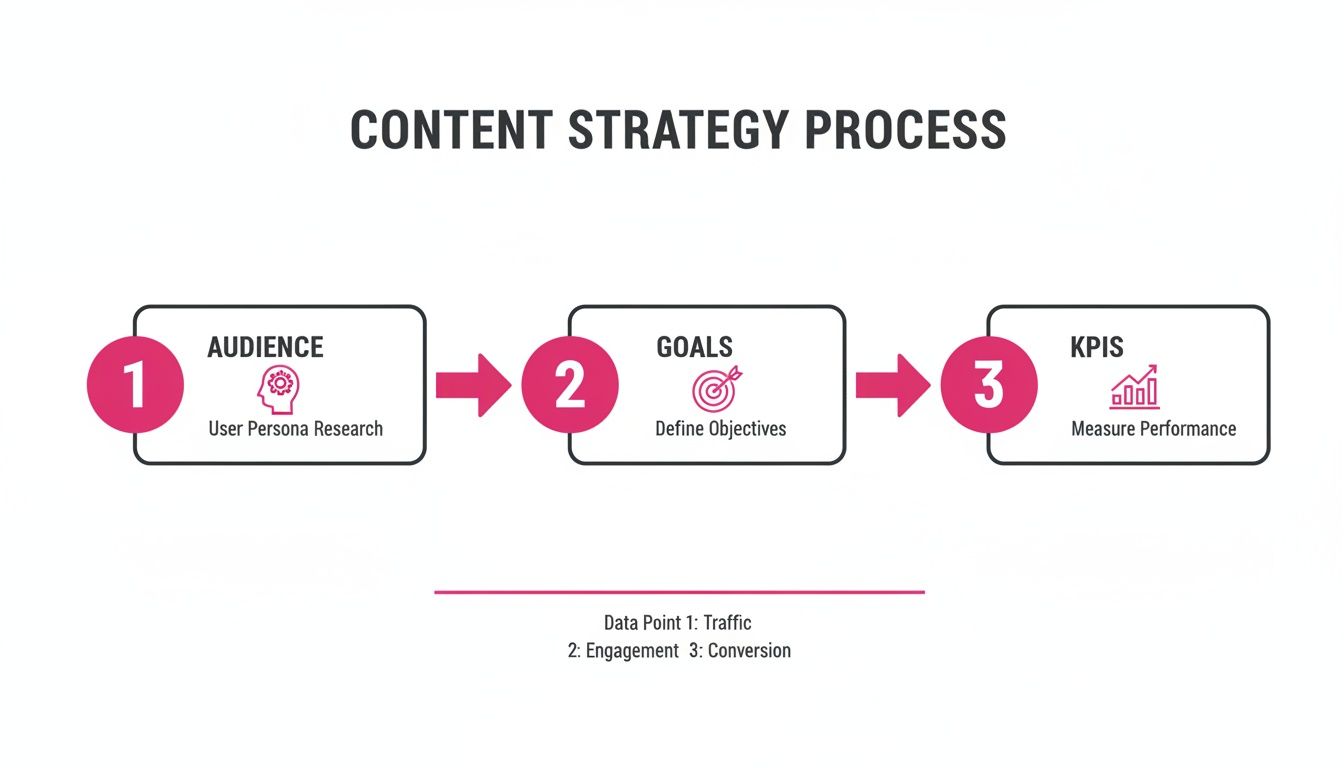
The key takeaway here? Your audience, goals, and metrics are all linked. It’s a constant feedback loop that should inform every creative decision you make.
From Brainstorming to Batching
Let’s start with ideation. The best way to never run out of ideas is to ground everything in your content pillars—the 3-5 core topics your brand owns. For us at AnimePhoto.ai, our pillars might be "Creative Avatars," "Social Media Tips," and "Anime Culture." This simple structure keeps our content focused and relevant.
From there, you move into scripting and copywriting. This is where the magic happens. Your number one job is to stop the scroll. That means crafting an irresistible hook within the first three seconds of a video or the first line of a caption. Give people a reason to stop and listen.
Next up is visual production. Let's be honest: in today's feeds, generic visuals are basically invisible. This is your chance to really carve out a signature style. Maybe it's a specific color palette, a consistent font pairing, or unique graphic elements that make your content instantly recognizable as yours.
For instance, your profile picture is your digital handshake. A tool like AnimePhoto.ai can turn a simple headshot into a custom anime-style avatar that pops, reflecting your brand's unique personality across every platform. To dig deeper into making your images stand out, our guide on essential photo editing techniques is a great place to start.
The Power of Efficient Production
The demand for new content is absolutely relentless. With short-form video dominating platforms like TikTok and Instagram, some experts recommend posting a staggering 48 to 72 times per week just to stay visible. It’s no wonder 83% of social marketers say they rely on AI tools to help them create more content, faster.
This is exactly where batching becomes your superpower. Instead of making one post at a time in a constant state of panic, you dedicate focused blocks of time to create a week’s—or even a month’s—worth of content all at once.
Pro Tip: Try this: block out one day just for filming all your video clips. Use another day for designing all your graphics. Dedicate a third to writing and polishing all your captions. This "assembly line" approach is monumentally more efficient than constantly switching hats.
When you batch your work, you get into a creative flow that not only speeds things up but often improves the quality of the final product. It’s the single best-kept secret for staying ahead without burning out.
Scheduling and Staying Organized
The final piece of this puzzle is scheduling. A well-planned content calendar is your command center. It gives you that crucial bird's-eye view of everything you have planned, making sure you have a healthy mix of content pillars and formats going out.
Using a scheduling tool is a non-negotiable for serious creators. It helps you:
- Post at optimal times when your audience is actually online and scrolling.
- Maintain a consistent presence without being chained to your phone 24/7.
- See your entire strategy at a glance to spot gaps or opportunities for improvement.
This repeatable workflow—from ideation and scripting to visual creation, batching, and scheduling—is what separates hobbyists from pros. It turns the chaotic, often stressful process of making social media content into a streamlined system that gets predictable, powerful results.
Crafting a Visual Identity That Captures Attention
On social media, your visuals are everything. They're your first impression, your handshake, and the personality of your brand, all packed into a single glance. Before anyone even thinks about reading your caption, they see your image or video. If it looks generic, they'll just keep scrolling.
Let's be real: a strong visual identity is way more than just picking a few pretty colors. It's about building a consistent, recognizable style that telegraphs who you are instantly. This is how you stop the scroll and build a following that knows your content the second they see it.

The image above is a great example. Simple, bold elements can create a look that's both distinct and memorable. Consistency in your fonts, colors, and layout is what makes your content pop in a sea of sameness.
Your Profile Picture Is Your Digital Handshake
Out of all your visuals, your profile picture is the most critical. Think about it—that tiny icon follows you everywhere. It's next to every comment, every post, every story. It has to be clear, compelling, and instantly recognizable, even when it's shrunk down to the size of a thumbnail.
Don't underestimate this. With 72.3% of people using social media to research brands, your avatar is often their very first point of contact. And since the average person juggles 6.75 different platforms a month, a consistent and unique profile picture is crucial for building that cross-platform recognition. You can dig into more of these stats over at sixthcitymarketing.com.
A generic avatar is a missed opportunity. Your profile picture should be a magnet for your target audience, reflecting the personality and niche of your brand.
For creators, especially in niches like gaming, tech, or art, a custom avatar is a game-changer. It gives you immediate visual differentiation, helping you cut through the noise and connect with the right community from the get-go.
Creating a Standout Avatar with AI
So, how do you create a profile picture that truly pops? This is where you can get a massive creative edge by using the right tools. Instead of a standard headshot, you can generate a custom piece of art that nails your brand's vibe.
For instance, a tool like AnimePhoto.ai can turn a simple photo of you into a one-of-a-kind anime-style illustration. This isn't just about looking cool; it's a strategic move. You're aligning your visual identity with a specific aesthetic that really speaks to your target audience.
The process is surprisingly simple:
- Upload Your Photo: Just start with a clear, well-lit headshot.
- Choose Your Style: Pick an aesthetic that fits your brand. A gaming streamer might go for a dynamic "Cyberpunk" style, while a lifestyle creator might prefer a softer "Chibi" look.
- Generate and Go: The AI creates a unique avatar in seconds. You can then use that image everywhere to build a consistent presence.
Building a Cohesive Visual System
Beyond your profile picture, every single visual you post should feel like it belongs to the same family. A cohesive visual system makes your brand feel more professional, trustworthy, and—most importantly—memorable.
To pull this off, you need to set some clear ground rules for your visuals.
- Color Palette: Stick to 2-3 main colors and 1-2 accent colors. This creates that consistency that strengthens brand recall.
- Typography: Pick one or two fonts and use them consistently. A clear hierarchy—one font for headlines, another for body text—makes everything easier to read.
- Image Style: Decide on a consistent feel for your photos and graphics. Are you going for bright and airy? Dark and moody? Or vibrant and energetic?
By defining these elements, you're essentially creating a visual language that speaks for your brand. This system not only makes it easier to create social media content but also ensures every post reinforces your identity. Before you know it, your brand becomes impossible to ignore. For more inspiration, check out our guide on creating a memorable look with an anime profile picture maker.
How to Build Your Next 90-Day Content Calendar

A brilliant strategy is just a collection of good ideas until you put it into action. This is where your content calendar comes in—it’s the bridge that turns your big-picture goals into a consistent, daily reality. Think of it less like a spreadsheet to fill and more like a strategic map for the next quarter.
When you plan ahead, you kill that daily panic of "what on earth am I going to post today?" This frees up so much mental space, allowing you to be more creative and strategic, and most importantly, to show up for your audience every single day. Breaking your plan into a 90-day window turns your marathon into manageable monthly sprints.
The First 30 Days: Foundational Consistency
Your first month is all about laying the groundwork. You’re building a rhythm. Right now, the number one goal is consistency. You have to train your audience to expect content from you, proving that you’re a reliable source of value they can count on.
Stick to your core content pillars—those 3-5 main topics you decided on earlier. This keeps your message tight and helps you carve out your space in a niche much faster. Don't get distracted by every shiny new trend or format just yet.
- Goal: Nail down a consistent posting schedule and hammer home your core content pillars.
- Key Content: Think educational carousels, behind-the-scenes Stories, and simple "how-to" video clips.
- Example Post (for a fictional plant shop): A three-slide carousel titled "3 Common Mistakes New Plant Parents Make." Each slide tackles one mistake with a clear solution, which perfectly reinforces their "Plant Care Education" pillar.
This phase is about building habits—for you as a creator and for your audience as followers. Just show up, deliver value, and stick to the plan.
The Next 30 Days: Diversification and Engagement
Okay, you've got a solid foundation. Month two is where you can start to play a little and really connect with your community. The focus shifts from just broadcasting your message to sparking a real, two-way conversation.
Now's the time to introduce new formats and get your audience involved. The data you gathered from your first 30 days will give you some great clues about what’s landing well. Did a particular topic get a ton of saves? Great, let's make a more in-depth video about it.
By actively involving your audience, you're not just creating content for them; you're creating it with them. This shift builds a loyal community that feels seen and heard.
Try mixing in a few of these elements:
- User-Generated Content (UGC): Reshare your customers’ photos or posts (always with permission and credit, of course!). This is powerful social proof and makes your followers feel like part of the brand.
- Interactive Polls and Quizzes: Use Instagram or X Stories to ask your audience questions. It's a super easy, low-effort way to boost engagement and get valuable feedback.
- Test a New Format: If you’ve been doing a lot of static images, why not try creating your first Instagram Reel or a short-form video?
For example: Our plant shop could run a Story poll asking, "What's the #1 plant you struggle to keep alive?" The answers are pure gold—direct inspiration for their next batch of educational content.
The Final 30 Days: Scaling and Optimization
The last month of your 90-day plan is all about smart growth. By now, you've got some real performance data to work with. You can finally move from guessing what works to knowing what works.
It's time to dive into your analytics and hunt for patterns. Which posts drove the most website clicks? Which videos had the highest retention rate? The answers are your roadmap for the next quarter. The goal here is simple: double down on your winners.
Your optimization process should look something like this:
- Identify Top Performers: Find the 3-5 posts from the last 60 days that crushed it in terms of engagement, reach, or clicks.
- Analyze the "Why": Get curious. Why did they do so well? Was it the hook in the first three seconds? The format? The specific topic?
- Create Variations: Brainstorm how you can create new content inspired by these home runs without just reposting the same thing.
Let's go back to our plant shop: They noticed their carousel about "mistakes" performed exceptionally well. For month three, they scale that concept by creating a Reel titled "The BIGGEST mistake you're making with your Fiddle Leaf Fig." This uses proven data to make a smarter content decision, ensuring their effort creates a bigger impact over time.
To help you visualize this journey, here’s a simple framework to guide your focus over the next three months.
30/60/90 Day Content Focus Plan
| Timeframe | Primary Goal | Key Content Types | Example Tactic |
|---|---|---|---|
| First 30 Days | Establish Consistency & Authority | Core pillar content (carousels, simple tips) | Post 3x a week on your main educational topics. |
| Next 30 Days | Deepen Engagement & Community | Interactive content (polls, Q&As, UGC) | Run a weekly "Ask Me Anything" session in Stories. |
| Final 30 Days | Optimize & Scale Winners | Data-driven content (top-performing formats) | Turn your most-saved carousel into an in-depth Reel. |
This plan isn't about being rigid; it's about being intentional. It gives you the structure to be creative and the data to be effective, setting you up for long-term success long after these 90 days are over.
Turning Analytics Into Smarter Content Decisions
So you’ve created and published your content. That’s a huge step, but it’s only half the game. The real growth kicks in when you stop guessing what your audience wants and start listening to what their actions are telling you. This is where analytics comes in—not as a scary wall of numbers, but as a roadmap to creating better, more effective content.

Think of every like, share, and comment as a vote. Your job is to count those votes and figure out which of your ideas are winning. When you start digging into your data, you create a powerful feedback loop that makes every new post smarter than the last.
Identifying the Metrics That Truly Matter
It’s way too easy to get lost in a sea of data. Vanity metrics like follower counts and impressions can give you a nice ego boost, but they don't tell the whole story. To make smart moves, you need to zero in on the numbers that show how your audience is actually interacting with what you post.
Here are the key metrics that I always keep an eye on for real, actionable insights:
- Engagement Rate: This is the big one. It’s the percentage of people who saw your post and actually did something—liked, commented, shared, or saved. A high engagement rate is the clearest sign that your content is hitting the mark.
- Saves: When someone saves your post, it's a huge compliment. They found it so valuable that they want to refer back to it later. This metric is a goldmine for identifying your most useful and evergreen content.
- Shares: A share is basically a personal endorsement. Someone liked your content so much they were willing to put their own reputation on the line by showing it to their network. Shares are a massive driver of organic reach.
- Click-Through Rate (CTR): If your main goal is to drive traffic to your website or a landing page, CTR is your north star. It tells you exactly how many people who saw your post cared enough to click the link.
Focusing on these moves you past the surface-level stuff and helps you understand the real-world impact of your work.
Finding the Stories in Your Data
Every platform, from Instagram and TikTok to LinkedIn, has its own native analytics dashboard. Your mission is to put on your detective hat and look for patterns that tell a story about what your audience truly loves.
I recommend starting by asking specific questions as you look back at your performance over the last 30 days.
- What was your single best-performing post? Find the one with the highest engagement rate and break it down. Was it a carousel? A Reel? What was the topic? The hook? The call to action?
- Which posts racked up the most saves? This is how you identify your most helpful content. These are the topics you should absolutely revisit from different angles.
- Where are people dropping off in your videos? Most platforms have audience retention graphs. If you see a massive drop-off after the first three seconds, you know you’ve got a problem with your hooks.
The goal isn't just to find your most popular post. It's to understand why it was popular so you can replicate that success again and again.
For instance, you might notice that your carousels explaining a step-by-step process get 3x more saves than your single-image posts. That’s not just a cool stat; it’s a direct instruction from your audience on what to create next.
Putting Insights Into Action
Data doesn’t do you any good if you don't act on it. This is where you close the loop, turning your analysis into a concrete content plan for the next month. Based on what you’ve learned, you can make strategic adjustments instead of just winging it.
Here’s what this looks like in the real world:
| Data Insight | Actionable Content Decision |
|---|---|
| Your "behind-the-scenes" Stories consistently get the most replies. | Make "A Day in the Life" a weekly feature in your content calendar. |
| A video starting with a question hook had an 80% watch time. | Start your next three videos with a direct question to hook the viewer. |
| A post debunking a common industry myth got a ton of shares. | Create a new content series called "Myth-Busting Mondays." |
This cycle of analyzing and adapting transforms content creation from a creative gamble into a data-informed strategy. You stop throwing spaghetti at the wall to see what sticks and start building on a foundation of what you know already works. It’s the most reliable way to create content that not only gets seen but also drives real results.
A Few Common Questions About Content Creation
Even with the best workflow in place, creating social media content can throw you a curveball. Questions are bound to pop up, whether you're wondering how often you really need to post or which tools are actually worth your time. Let's tackle some of the most common hurdles creators hit.
Think of this as the troubleshooting guide for your content engine. Getting these answers straight will help you move forward with more confidence, making your entire process smoother and more effective.
So, How Often Should I Actually Be Posting?
This is the million-dollar question, and the honest answer is: there's no magic number. The right posting frequency really comes down to the platform, your niche, and what you can realistically sustain without burning out.
Here’s the golden rule I always tell people: consistency beats frequency, every single time. It's far better to show up with three amazing, high-value posts each week than it is to scramble and push out seven mediocre ones just to hit a quota.
As a solid starting point, aim for 3-5 quality posts per week on platforms like Instagram and Facebook. For something like X (formerly Twitter) or TikTok where the feed moves lightning-fast, you might find that daily posting is what it takes to stay on people's radar.
The real secret? Start with a schedule you know you won't break, and then dive into your analytics. The data will tell you exactly when your audience is online and ready to engage.
Let the numbers guide you, and you'll take all the guesswork out of the equation.
What Are the Best Tools for Creating Content?
Having a solid toolkit is a game-changer. The right apps can help you create professional-looking content without spending your entire day glued to a screen. Your go-to stack should cover design, video, and scheduling.
Here are a few of my favorites that deliver incredible results:
- For Jaw-Dropping Visuals: Canva is the undisputed champ for a reason. If you're not a graphic designer, its templates and easy-to-use interface are a lifesaver for creating stunning graphics and carousels.
- For Pro-Level Video Editing: You can't go wrong with CapCut on mobile or DaVinci Resolve on your desktop. Both are packed with powerful features—and they're free. They give you everything you need to edit polished, engaging videos.
- For a Truly Unique Vibe: To really break through the noise, you need something distinct. A specialized tool like AnimePhoto.ai is perfect for this. It lets you create custom anime-style avatars and illustrations that make your brand instantly recognizable.
- For Scheduling Like a Pro: To keep your posting rhythm consistent without living on your phone, a scheduler is non-negotiable. Tools like Buffer, Later, or even the native Meta Business Suite let you plan and schedule everything in advance.
I'm Stuck. How Do I Find New Content Ideas?
We've all been there—staring at a blinking cursor with zero inspiration. The trick is to stop trying to pull ideas out of thin air and start looking in the right places.
First, do the simplest thing that always works: ask your audience what they want. Seriously. Throw up a Q&A sticker on Instagram Stories or run a quick poll on X. The answers you get are pure gold because they tell you exactly what content will resonate.
Next, get familiar with free tools like AnswerThePublic. Just type in a keyword from your niche, and it will spit out a huge web of questions people are actively searching for online. It's an absolute goldmine for finding relevant topics your audience is curious about.
Finally, take a peek at what your competitors are doing. Don't copy them, but analyze their top-performing posts. What topics are getting traction? What formats are people loving right now? Use that intel as a jumping-off point to create your own unique spin.
Ready to create a visual identity that truly stands out? With AnimePhoto.ai, you can transform your photos into unique anime-style avatars in seconds. It’s the perfect way to make your profile pop and build a memorable brand across all your social platforms. Try it now and create your custom avatar!

See yourself in anime style in under a minute
Pick a style, upload a photo, and get a high-quality anime portrait ready for profiles, prints and gifts.
Create your anime photo